
How viable is sustainable floristry? Part 1: The 10% trigger
In 2024, I wrote a piece called What is Sustainable Floristry. In it, I promised to follow on with my thoughts on how sustainable floristry can be viable in today’s world.
Almost two years on, that question has been simmering quietly in the back of my mind. And now, I want to try to answer it - not in one go, but in a series of journal entries over the coming months.
The long and short of it is it’s complicated. But I believe there are a number of levers - on both the supply and demand side - that, if pulled, could create real, lasting change in the floral industry.
Today, let’s start with the demand side. And something I call the 10% trigger.
The Rise of the Values-Led Consumer
Many years ago, I was living in Singapore, working in a small company looking at consumer trends across Asia. They had conducted a significant piece of research focused on a new kind of customer (first identified in Boulder, Colorado) who wasn’t shopping based on price or brand, but on personal values around health, wellness, sustainability.
Back then, they were called LOHAS (Lifestyle of Health and Sustainability) consumers. Today, they’re more commonly known as values-led consumers. They’re climate-aware, digitally fluent, and actively seek out brands aligned with their beliefs.
And they’ve been quietly changing markets.
The 10% Trigger
I remember sitting in a meeting with a large FMCG beauty brand. They’d just redone a significant market study on shampoo sales, comparing their leading products to everything else in the category.
Five years earlier, the big household brands had controlled 95% of the market. The “other” category? They held just 5%.
But now that “other” bucket had tipped past 10%. And this had made the executives sit up and pay attention.
What was going on? It turns out, that 10% was made up of brands speaking directly to the values-led consumer. And this segment had grown by 5% in 5 years. The company’s response? They realised they had better understand this customer, and start to develop an offering that met their needs around formulations, packaging and sustainability…
The customer was driving change - and the industry was beginning to respond.
(I recognise that the beauty industry is still far from perfect. But supply chains have improved. And that shift in customer behaviour was instrumental.)
Change Happens When People Feel Good
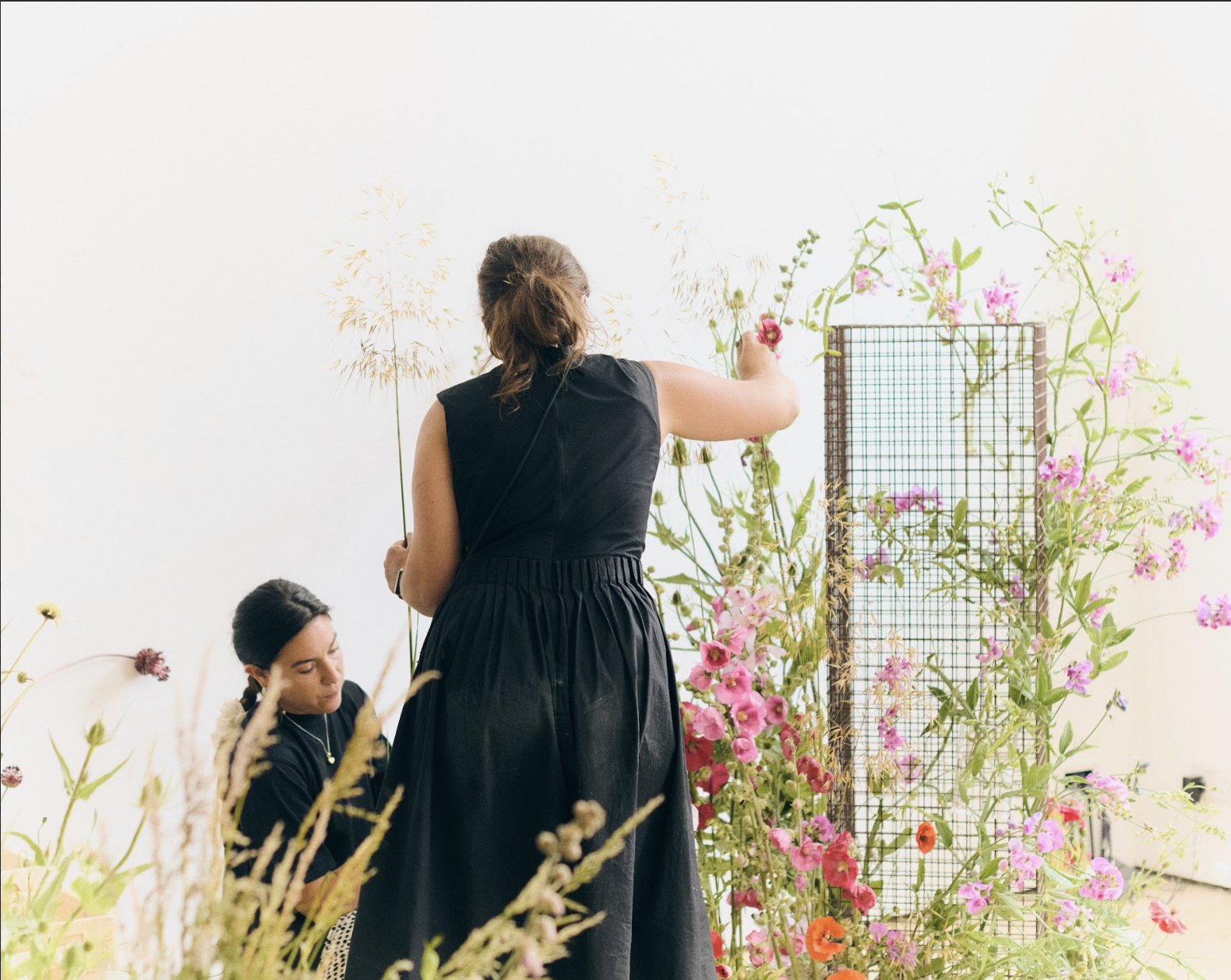
Behind the scenes: Mora Floral Design installing at Flowers on the Edge, photographer: Tilly Wace
The second insight from that time: people don’t change behaviour because they’re guilted into it. You can throw facts, stats, and horror stories at them, but it rarely works.
Real change happens when people want something. When the sustainable option feels beautiful, joyful, and aspirational. That’s when they buy it. And if they get to feel good and virtuous? Even better.
Which brings me back to floristry.
Season-Led Floristry is the “Other”
Today, season-led floristry - local, sustainable, design-forward - still sits under the 10% mark. But it’s closing in. And that matters.
Influential names are taking note, with locally grown flowers centre stage at the Royal Weddings and for Charli XCX’s summer wedding. Floral design exhibitions like Flowers on the Edge, British Flowers Week at the Garden Museum and Strawberry Hill House Flower Festival are also helping to shift perception.
Season-led floristry is no longer just a fringe movement. It’s becoming aspirational.
And once we cross that 10% threshold, the rest of the industry won’t be far behind…
UPDATE:
Since I wrote this blog, the Church of England has received a motion from the Sustainable Church Flowers organisation for the General Synod (the national assembly and legislative body of the Church of England,) to consider at its February meeting. two distinct proposals, namely to:
Promote and encourage, wherever possible, locally and seasonally sourced flowers and foliage; and
Eliminate the use of floral foam.
On the question of the encouragement to source flowers locally and seasonally, sustainable sourcing is not binary. Encouraging locally grown flowers is NOT the same as banning imports. Equally, it is not as simple as saying ‘buy local’. As we found in our Buying Better report, co-authored with Olivia Wilson of Wetherly, nuance is important. There have been important strides in sustainability within the global floriculture industry. The Church promoting greater awareness and education around provenance and sustainability of cut flowers can only be a good thing. Our upcoming campaign for Better Labelling and increased transparency in cut flower supply chains feels even more vital now. (More information to follow.)
When it comes to floral foam, things feel less nuanced. I am reminded of big tobacco’s reluctance to acknowledge the harm that cigarettes causes, in spite of considerable evidence to the contrary. The body research identifying the negative environmental impact of floral foam is already significant. (Sustainable Flowers Research Project and Sustainable Floristry Network have already written extensively about this…)
Concern has been raised that bans risk harming innovation and progress within the industry… But, progress is not always linear. Often disruption is exactly what propels innovation forward. If the COVID pandemic taught us anything, it’s that necessity can accelerate innovation, and that our industry is highly adaptable.
Florists around the world have been embracing foam-free ways of working for years, and experience shows that when customers are given clear explanations behind design decisions, most are receptive to these positive changes. It comes back to education and awareness, and florists are uniquely positioned to play this role.
Certainly, some florists will have to pivot. But this doesn’t always have to be a threat. This is also an opportunity - to engage more closely and build relationships with our customers, so we become the trusted choice.
But ultimately, it comes back to the market. We live in a world where the market allocates resources according to market demand. The Church is not only a faith institution. It is also a significant values-led customer that has the right to decide what materials are brought into its ‘house’. In following the example set by the RHS, which banned floral foam in 2020, this is yet another signal that the market wants change.
I think it is also worth noting that, to date, the mainstream sustainable floristry debate has largely centred on the question of floral foam and the prevalence of single-use plastics.
As far as we are aware, this motion at the General Synod marks the first instance that the provenance of cut flowers and their sustainability have been placed front and centre in this kind of debate by such an influential institution.
The Church of England represents a significant ‘customer’ within the UK floristry industry, and Synod approval of this motion would mark a significant movement towards the 10% trigger. I await the General Synod’s decision in a couple of weeks.